One-sided tracking is a symptom, not a diagnosis. Before adjusting the guide, record the direction, timing and operating context of the drift, then review fabric condition, roll and guide alignment, shower and cleaning practice, seam condition, and any recent changes. A guide adjustment made before those observations are captured can remove the evidence needed to understand the condition. This page explains what each check can and cannot tell you, without assuming a single universal cause.
What one-sided tracking does and does not tell you
A fabric moving towards one side tells you that the running line is no longer where the mill expects it to be. It does not, on its own, identify whether the origin is in the fabric, the machine, the operating practice, or a combination of these. Treating the direction of movement as a verdict is the most common reason a guiding issue returns after an adjustment.
The useful first distinction is between a steady drift that develops over time, a sudden shift that begins after a defined event, and an intermittent movement that appears and disappears. These three patterns point towards different classes of review, and none of them is established by a single observation at the console.
Record the pattern before anything is changed. Once a guide is moved, the original condition is no longer available for comparison, and the team loses the baseline that makes a later review meaningful. See the forming fabric guiding overview for the full symptom-led workflow.
Why the guide should not be the first adjustment
A guide system responds to the fabric's position; changing it changes the response, not necessarily the condition that produced the movement. Adjusting first can stabilise the running line while leaving an underlying alignment, contamination or fabric condition in place, which is why the same drift often reappears after a shutdown or a fabric change.
This is not an argument against adjusting the guide. It is an argument for capturing the pre-adjustment state first: the direction of travel, whether the movement is continuous or periodic, when it began, what else changed at the same time, and what the guide position was before intervention. With that record, a later adjustment can be interpreted. Without it, every subsequent observation is measured against an unknown starting point.
| Pre-adjustment record | What it allows the team to distinguish |
|---|---|
| Direction and pattern of movement | A local condition versus a section-wide condition |
| Time of onset and any same-day event | A change-driven condition versus a developing one |
| Guide position before intervention | Whether a later adjustment held or progressively increased |
| Paper grade and production context | Whether the observation is tied to a specific running context |
| Recent fabric, roll, shower or cleaning work | Which variables changed together |
Why friction and tension belong in the first review
Friction between the guide roll and the fabric is central to how guiding works: where one edge meets more friction, a cross-direction force tends to move the fabric toward that side. The same principle applies to every component that touches the fabric, so a stationary dewatering or vacuum element that is out of alignment can influence the running line as much as a roll.
That friction depends on the machine state. Tension affects surface friction at the guide roll, while water trapped between the roll and the fabric acts as a lubricant and reduces the guiding system's effectiveness. That is why showering changes are usually considered late in a review rather than first. Roll cover condition and contact around the guide roll belong to the same group of checks.
Two recording points follow, neither of which requires a value to be written into the article: check tension on both the tending and drive sides at the same position, and confirm that the measuring device is itself giving correct values. A guide sensor set too sensitively can also transfer normal fabric oscillation into unnecessary guide movement, so an apparently intermittent drift can originate in the sensing system rather than in the fabric.
These are mechanisms, not settings for a particular machine. Use the fabric supplier's data sheet and the mill's established operating procedure for any tension decision; do not substitute a generic value found online.
Fabric-side conditions that can shift the running line
The fabric itself can contribute to a change in running line through uneven condition across its width. Local contamination, a difference in surface condition from one edge to the other, a seam that behaves differently along its length, or a change in how the fabric sits on the machine can all influence tracking without any fault in the guide system.
The mechanism is usually a difference in how one region of the fabric contacts or releases from the rolls, rather than a global property of the fabric. That is why a width-wise comparison is more informative than a single reading or a single photograph: the question is whether one side behaves differently from the other, and whether that difference is stable or moves with the fabric's rotation.
Do not treat an edge symptom as proof of a fabric defect. Edge condition, guide contact, shower coverage, roll surface state and installation details may all be involved, and they are reviewed together rather than in isolation. A forming fabric range review can help frame which construction and seam details are relevant to a given position, but the running observation still has to come from the mill.
Machine-side conditions that can shift the running line
Alignment, roll surface condition, shower and cleaning practice, and the state of the guiding equipment can each change the running line. Their effects are often interdependent: a local cleaning issue can change surface behaviour, which then makes an alignment condition visible that was previously tolerable.
A mechanism-led review asks which conditions changed before the drift began, not which component looks unusual at the moment of inspection. Roll and guide alignment, shower coverage consistency, and the condition of contact surfaces are reviewed as a group. The objective is to separate a condition that was introduced by a maintenance action from one that developed gradually during production.
Where tension or tracking readings exist, they are meaningful only with their measurement context — the instrument, location, procedure, machine condition and date. Values collected under different procedures should not be compared as if equivalent. The paper machine fabric tension checks guide describes what to document before a reading is interpreted.
Why seam and edge observations are not proof of a single cause
A visible seam or edge irregularity is evidence of a condition, not evidence of its origin. The same appearance can follow from installation handling, guide contact, local cleaning, roll condition, or a combination of these. Assigning a single cause from appearance alone tends to produce a replacement that does not change the tracking behaviour.
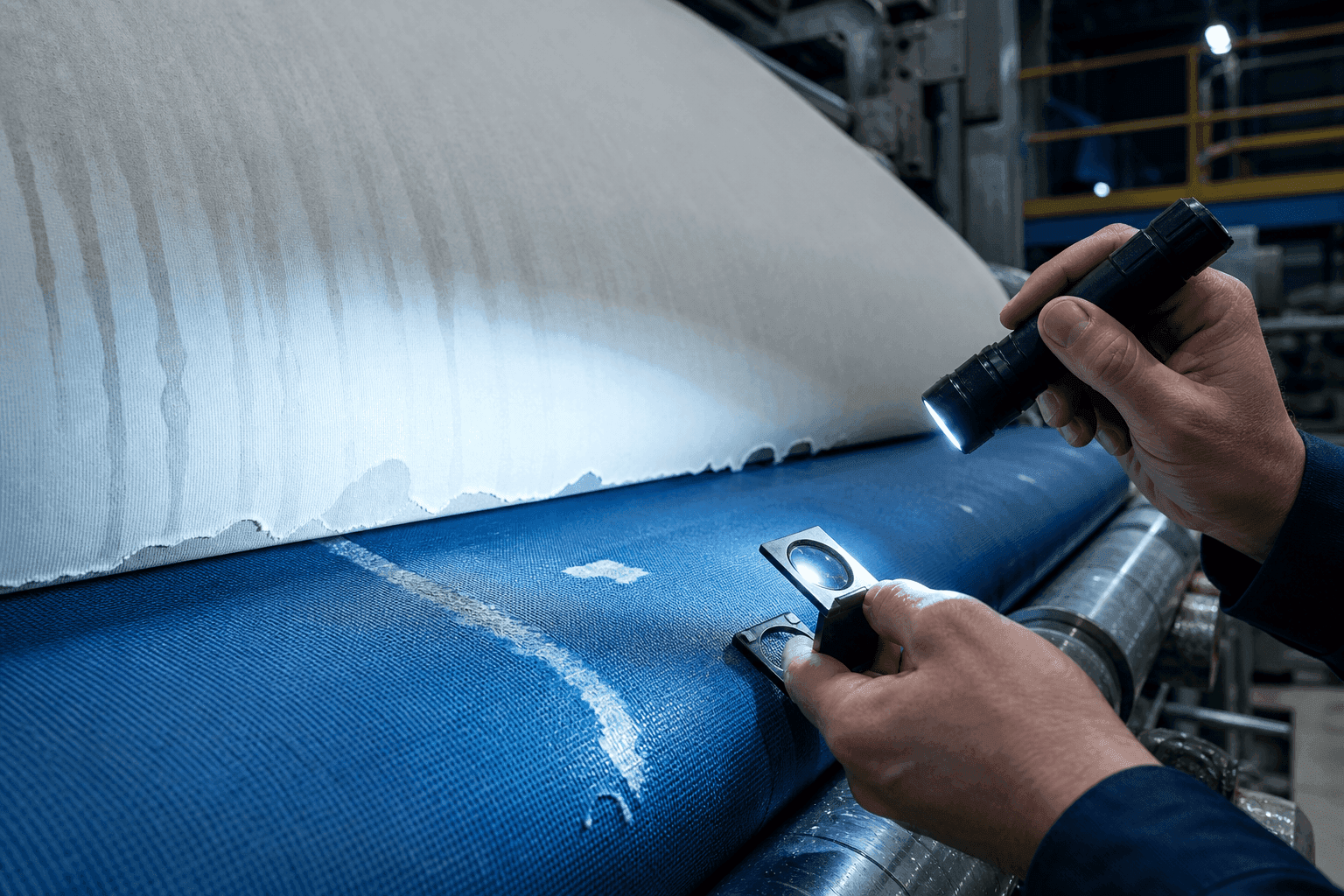
What makes the observation useful is its relationship to the fabric's rotation and to time: whether the irregularity returns at a consistent point, whether it progresses, and whether it coincides with the timing of the drift. Photographs taken from the same distance and position across more than one observation are usually more informative than a detailed description of a single moment.
Why timing and speed dependence matter more than the size of the drift
When the drift appears is often more diagnostic than how far the fabric moved. A condition that appears only after start-up, only under a particular production context, or only after a fabric change points towards a different review than one that develops steadily across a run.
Record the operating context alongside the observation: whether the machine was starting, running in a steady state, or returning from a stop; which paper grade was being produced; and whether the pattern repeated on the following run. The goal is a repeatable observation, not a single measurement. A condition that cannot be reproduced or placed in a timeline is difficult for a supplier to assess from a distance.
What to record before a technical review
A review becomes actionable when the mill can describe the condition in terms that an engineer can evaluate. The following record turns a general tracking complaint into a defined technical question:
- Machine section and exact forming position.
- Fabric identification and installation information, with the date of the current run.
- Paper grade and the operating context in which the drift appears.
- Direction, pattern and onset of the movement, and whether it repeats.
- Guide position and any adjustment made, with the time of each change.
- Comparable tension or tracking records where available, including the measurement method.
- Aligned photographs of both edges and the seam, taken through the mill's approved inspection process.
- Recent changes to rolls, showers, cleaning practice, guides or fabric.
This list is a documentation aid, not a diagnosis. For a position-specific review, Send us your machine parameters through the engineering enquiry form. The knowledge centre and the fabric selection tool may help identify which details belong to the position in question.
Frequently asked questions
Can one-sided tracking be corrected with a guide adjustment alone?
A guide adjustment can stabilise the running line, but it does not establish what produced the movement. Record the pre-adjustment state first so that a later review can tell whether the adjustment held or whether the condition returned for another reason.
Does a fabric that tracks to one side need to be replaced?
Not necessarily. A tracking change can originate in the fabric, the machine, the operating practice, or a combination. Replacement is a decision taken after the condition is documented and reviewed in context, not from the direction of drift alone.
Why does the drift sometimes disappear after a shutdown?
A change after a stop indicates that a condition was altered during the stop or during start-up. Which condition changed — cleaning, roll state, alignment, fabric seating, or operating context — can only be identified if those actions were recorded. Without that record, the disappearance is an observation without an explanation.
What should be sent to a supplier for a guiding review?
The eight records listed above. Position, fabric identification, paper grade, onset and pattern, guide history, comparable readings, aligned photographs, and recent changes give a supplier enough context to ask specific questions. A description of the drift without its timeline is usually not enough to proceed.