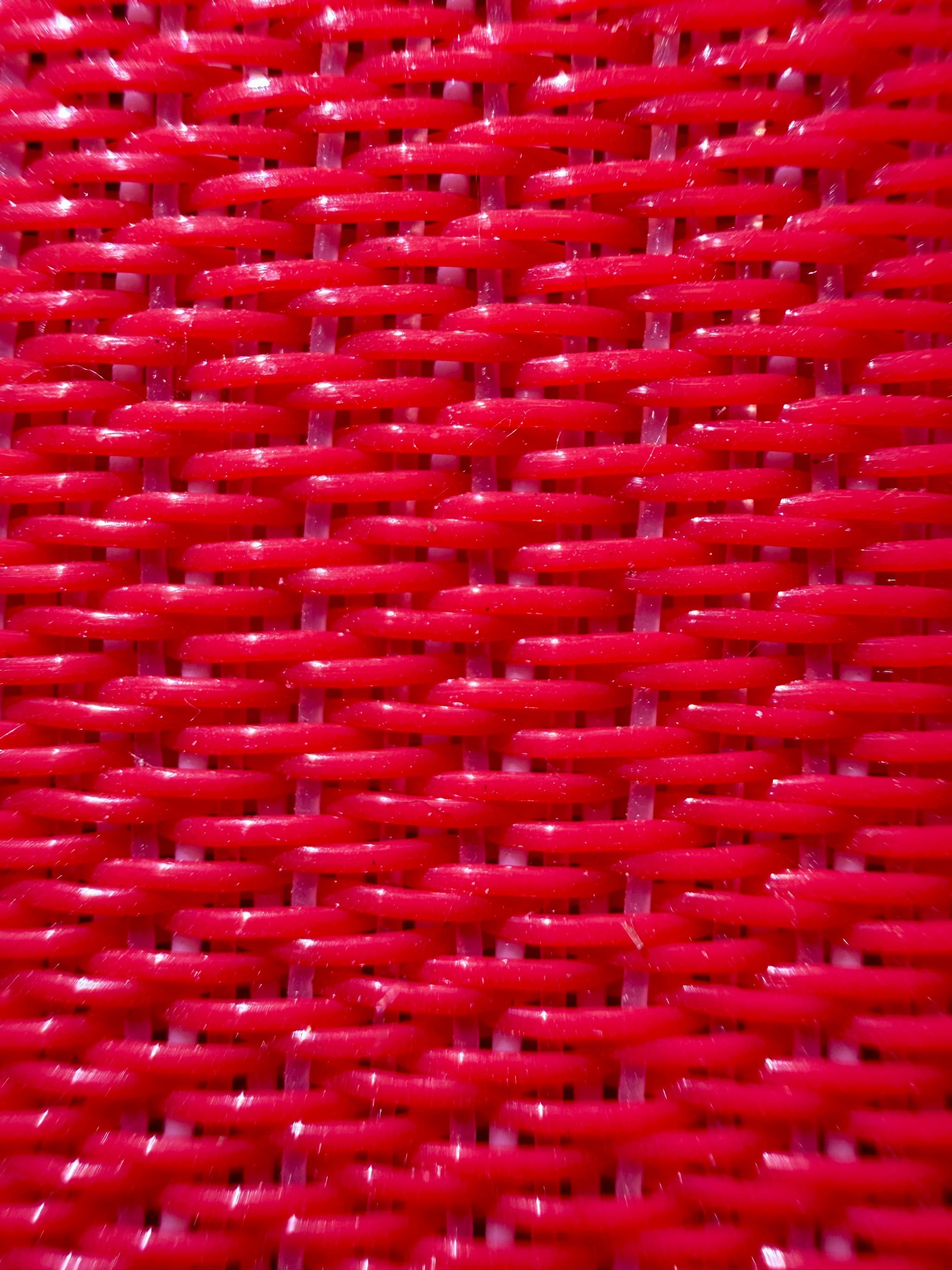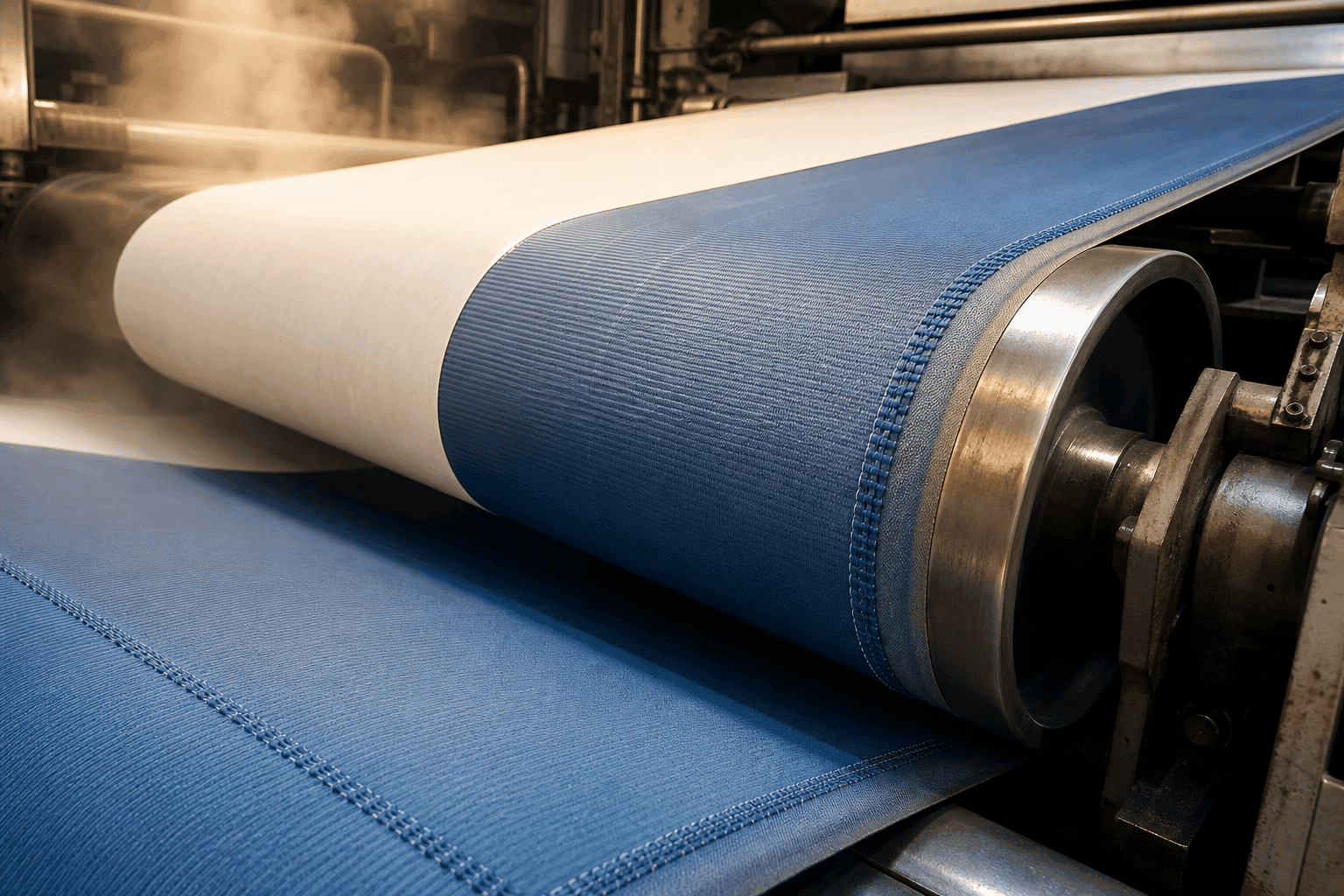
Choosing between round-yarn and flat-yarn dryer fabric starts with the yarn geometry and the actual dryer position. A product name alone does not tell you the air permeability, seam arrangement or suitability for a replacement. Two woven fabrics can use different yarn shapes, and a woven fabric can have a spiral seam without having a spiral fabric body.
This guide uses two PAPTEX specification sheets—GW22504K and BGW22608—to show what a buyer can compare, what remains unknown, and what to confirm before approving a replacement. These are two model examples, not performance ranges for every round-yarn or flat-yarn fabric.
Three descriptions that should not be confused
Round yarn or flat yarn describes yarn shape. Identify which direction uses that shape. The GW22504K sheet specifies round PET yarns in both directions. BGW22608 specifies flat warp yarn and round weft yarn. “Flat yarn” does not mean that every yarn in the fabric is flat.
Woven describes the fabric construction. Both examples are woven dryer fabrics. “Flat-woven” is not a synonym for “flat-yarn.” If a catalogue title is ambiguous, check the warp and weft dimensions on the approved specification.
Spiral seam describes the joining arrangement when used as a seam specification. GW22504K lists a spiral seam but remains a woven fabric. To compare woven flat-yarn fabric with a spiral fabric body, use the separate flat yarn versus spiral dryer fabric guide.
A model-by-model comparison from the source sheets
| Specification | GW22504K | BGW22608 |
|---|---|---|
| Construction | 4-shed, double-layer woven | 8-shed, 1.5-layer woven |
| Warp yarn | Round PET, Ø0.50 mm | Flat PET, 0.60 × 0.40 mm |
| Weft yarn | Round PET, Ø0.50 mm | Round PET, Ø0.60 / Ø0.50 mm |
| Listed air permeability | 11,200 m³/m²h (709 CFM) | 4,740 m³/m²h (300 CFM) |
| Caliper | 2.00 mm | 1.60 mm |
| Fabric tenacity at break | ≥2,000 N/cm | ≥2,000 N/cm |
| Seam description | Spiral seam | Mini-ring seam |
Source: PAPTEX technical parameter sheets titled 高抗水解红平织干网技术参数 and 高抗水解扁丝干网技术参数-1. The permeability values and parenthetical CFM labels are reproduced as recorded; neither sheet states the test pressure. Confirm the test method and pressure before comparing a supplier's results. The listed fabric breaking strength is not an operating-tension setting or a seam-strength rating.
See the full model pages for GW22504K and BGW22608.
Does the lower-permeability example mean flat yarn is always better?
No. The table establishes a difference between these two documented designs. It does not isolate yarn shape as the cause, because their weave, yarn dimensions and caliper also differ. It does not establish that either model will improve your drying rate, sheet quality, steam consumption or service life.
Use the current fabric specification and operating record as the starting point. Identify the dryer group and top or bottom position, paper grade and basis-weight range, normal operating speed and the reason for considering a change. Review the required permeability against that position and the machine builder's requirements. If the current and proposed figures were measured under different conditions, resolve that discrepancy before approving the specification.
For a position-based review, read the dryer fabric selection guide.
Four decisions before substituting one model for another
1. Confirm the requirement you are trying to change
Write down the observed issue: deposits, seam wear, guiding difficulty, sheet marking or uneven drying. Include when it appears and what changed before it started. A yarn-shape change should address an identified requirement; it should not be used as a substitute for investigating machine or operating conditions.
2. Compare dimensions and the complete construction
Check the approved length and width, weave, yarn dimensions and caliper together. Do not approve a replacement from “round,” “flat” or “same CFM” alone. Where the current specification is unavailable, mark it as unknown and provide the existing model label and available drawings for review.
3. Review the seam as a separate item
Confirm the proposed seam description against the current installation arrangement and machine-builder instructions. Matching the body permeability does not establish seam compatibility. Refer to the existing pre-start seam inspection checklist for the installation stage; this comparison is not an installation procedure.
4. Agree how the replacement will be evaluated
Before a trial, record the baseline grade mix, operating speed, reason for removal and available production or quality records. Agree which observations will support acceptance and which operating changes must be recorded. Avoid making a life or energy comparison across different operating conditions without accounting for those differences.
A short brief you can send for technical review
- Dryer group and exact top/bottom position.
- Paper grade, basis-weight range and normal operating speed.
- Current fabric model, dimensions, construction and seam, where known.
- Current permeability value, test method and pressure, where available.
- The problem to solve, relevant operating history and available photographs.
- The proposed change and any machine-builder constraints.
Use the blank machine clothing review form for the basic records; add the seam and test-condition details separately. Leave unavailable values blank or mark them unknown instead of estimating them.
Which model should you request?
Request a position review before choosing from these two examples. The documented GW22504K and BGW22608 specifications are starting points for comparison, not interchangeable recommendations. PAPTEX can review the information you have and identify what still needs confirmation.
Compare the dryer fabric range, or request a dryer fabric technical review. Include the model you are considering and the exact dryer position.