Why dryer fabric selection must be position-specific
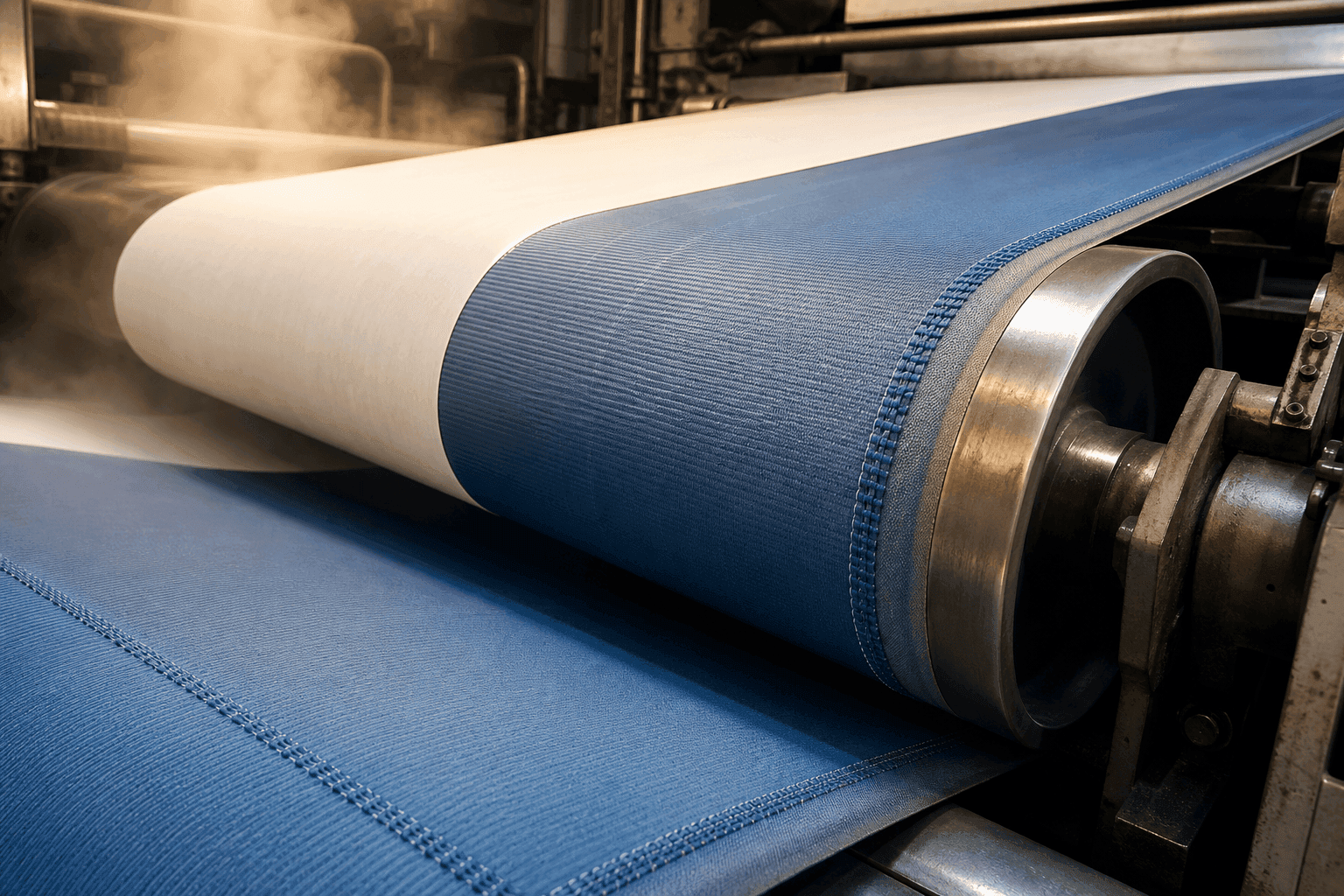
A dryer fabric is not selected by CFM alone. The correct design must balance sheet support, vapor removal, heat transfer, contamination resistance, dimensional stability and seam reliability at a specific dryer position.
How the documented CFM values change by position
The source records do not identify one universal CFM value for a complete dryer section. They record the following values within one position-dependent configuration:
| Recorded grouping | Documented air permeability |
|---|---|
| Front-group combination — recorded value 1 | 115 CFM |
| Front-group combination — recorded value 2 | 125 CFM |
| Front-group combination — recorded value 3 | 285 CFM |
| Other recorded position combination — value 1 | 380 CFM |
| Other recorded position combination — value 2 | 400 CFM |
The same documented configuration records fabric thickness of about 1.60–1.62 mm, seam strength of at least 800 N/cm and fabric-body strength of at least 2000 N/cm. These are application examples, not universal targets. They show why paper grade, basis weight, machine speed, steam pressure, pocket ventilation and the condition of cylinders and doctors must be reviewed for the exact position before a specification is selected.
1. Start with the operating position
Record the following before comparing fabric constructions:
- dryer group and single- or double-tier arrangement;
- paper grade, basis-weight range and furnish;
- machine width and normal/max speed;
- inlet and outlet moisture for the group;
- cylinder surface condition, steam pressure and pocket ventilation;
- contamination type, cleaning method and shutdown interval;
- current fabric structure, seam type, permeability and failure mode.
Without this operating map, a higher-permeability fabric can simply move the bottleneck or create uneven drying instead of increasing production.
2. Match permeability to the drying task
Permeability controls air and vapor movement through the fabric, but more is not automatically better. Excessive openness can reduce sheet support or make the drying profile harder to control. Too little openness can restrict pocket ventilation and increase contamination sensitivity.
PAPTEX parameter files illustrate the available design window:
| Documented design | Air permeability | Thickness | Fabric strength |
|---|---|---|---|
| Double-warp flat-yarn design | 300–500 CFM | application-specific | ≥1600 N/cm |
| BGW22608 hydrolysis-stabilized flat-yarn design | 300 CFM | 1.60 mm | ≥2000 N/cm |
| GW22504K hydrolysis-stabilized plain-weave design | 709 CFM | 2.00 mm | ≥2000 N/cm |
| Small double-warp design | 100–300 CFM | application-specific | ≥1600 N/cm |
These figures belong to the listed designs and test documents. They should not be copied directly to another machine without confirming the test standard and operating conditions.
3. Choose the structure: flat yarn, spiral or round yarn
Flat-yarn dryer fabrics
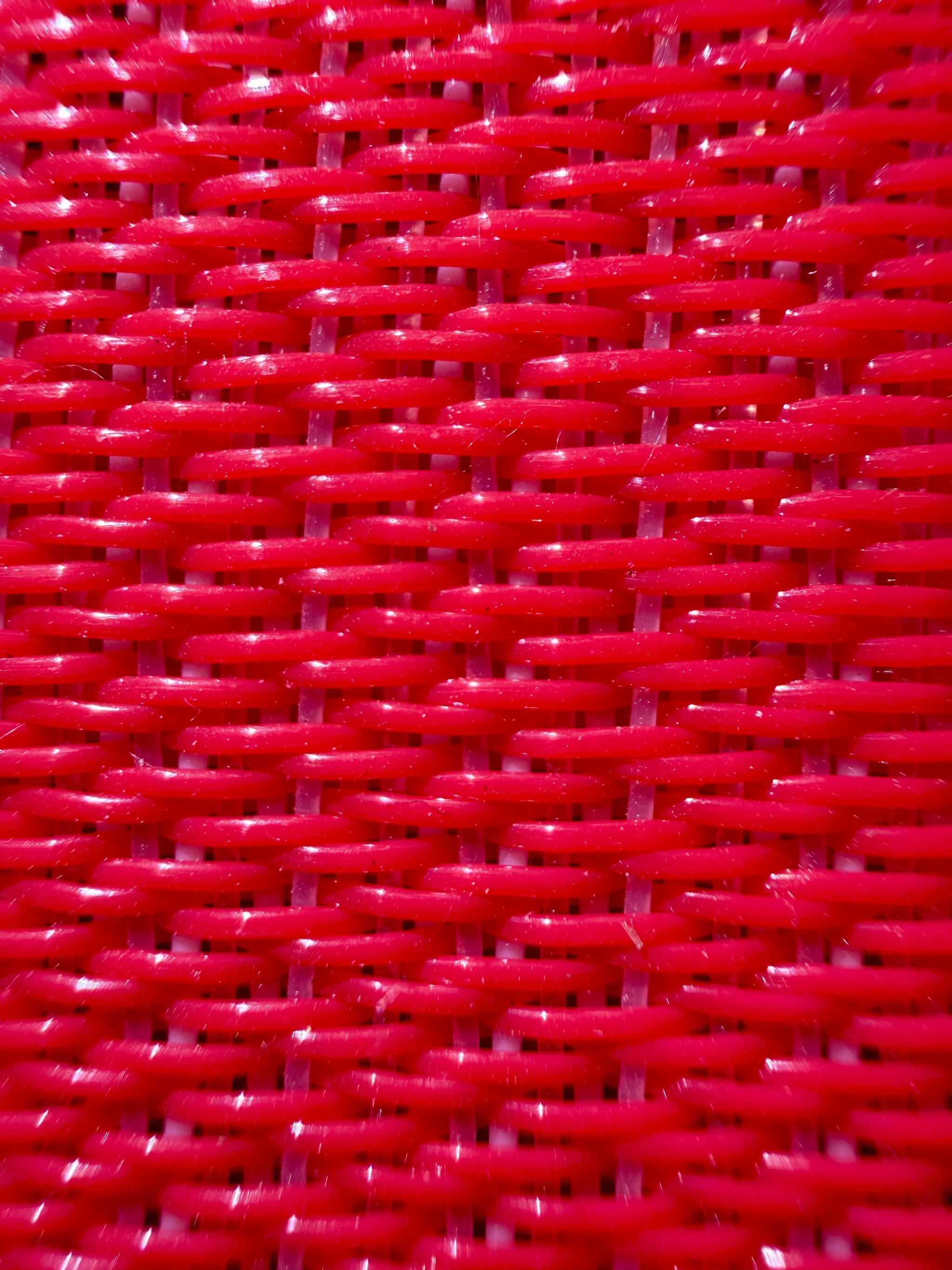
Flat warp yarn increases the contact area between the sheet and the fabric. This can support stable sheet travel and conductive heat transfer. PAPTEX's flat-yarn product family is used across medium- and high-speed dryer applications, while hydrolysis-stabilized variants are available for demanding hot and humid positions.
Review the Flat Yarn Dryer Fabric.
Spiral dryer fabrics
Spiral fabrics provide a seam construction that is easy to install and can be configured for different openness and contamination behavior. They are often considered where seam handling, cleaning or deposit release is a priority.
Review the Spiral Dryer Fabric.
Round-yarn and plain-weave designs
Round-yarn fabrics provide another balance of permeability, surface contact and cleanability. Plain-weave designs may be selected when stable geometry and a specific permeability window are required. The decision should be made from the position data, not the product name alone.
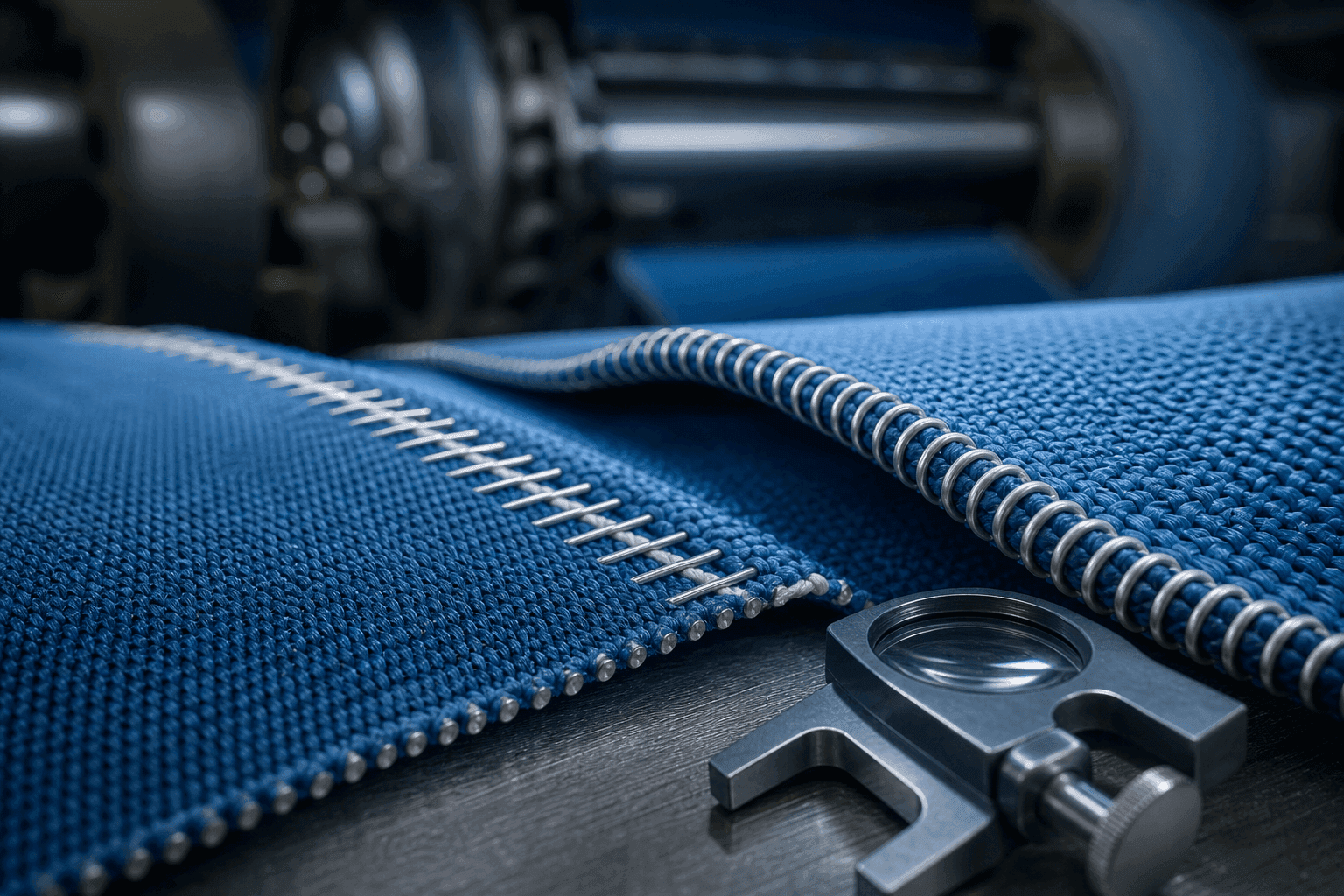
4. Check the seam as part of the fabric, not an accessory
The seam must pass through the machine without marking, opening or creating a local moisture difference. Confirm:
- seam construction and compatibility with the machine's installation space;
- seam strength relative to fabric-body strength;
- pin material and installation direction;
- loop alignment and closure procedure;
- the final seam profile under operating tension.
PAPTEX dryer proposals specify interface strength separately from fabric-body strength—for example, interface strength of at least 800 N/cm with fabric strength of at least 2000 N/cm in documented configurations. This is a useful reminder that both values need verification.
5. Account for hydrolysis, heat and contamination
Hot, humid dryer pockets accelerate polyester hydrolysis. If the current fabric loses strength, becomes brittle or fails earlier in the hottest groups, ask for a hydrolysis-stabilized yarn option and provide the actual temperature and moisture conditions.
Before attributing a failure to hydrolysis, use the hydrolysis-resistant dryer fabric replacement checklist to compare the observed damage with seam, edge and contamination symptoms and to prepare the evidence for a supplier review.
Deposits also change effective permeability during the run. Record whether the main contaminant is pitch, stickies, fines, coating color or oil, and describe the current cleaning chemistry and shower pressure. A clean laboratory CFM value cannot compensate for a structure that plugs rapidly in service.
RFQ checklist for an engineering recommendation
Send PAPTEX the machine position, paper grade, basis weight, width, speed, inlet/outlet moisture, steam pressure, current fabric specification, seam type, service life and failure photos. Our engineers can then compare flat-yarn, spiral, round-yarn and plain-weave options against the actual constraint.
Download the machine parameter form (CSV) to record the dryer position, paper grade, basis weight, speed, current fabric and steam conditions.
Request a dryer fabric recommendation or use the fabric selection assistant.
Key takeaway
The best dryer fabric is the design that maintains sheet support, ventilation, heat transfer and seam stability at one defined position. Use permeability as one controlled variable—not as the entire selection rule.