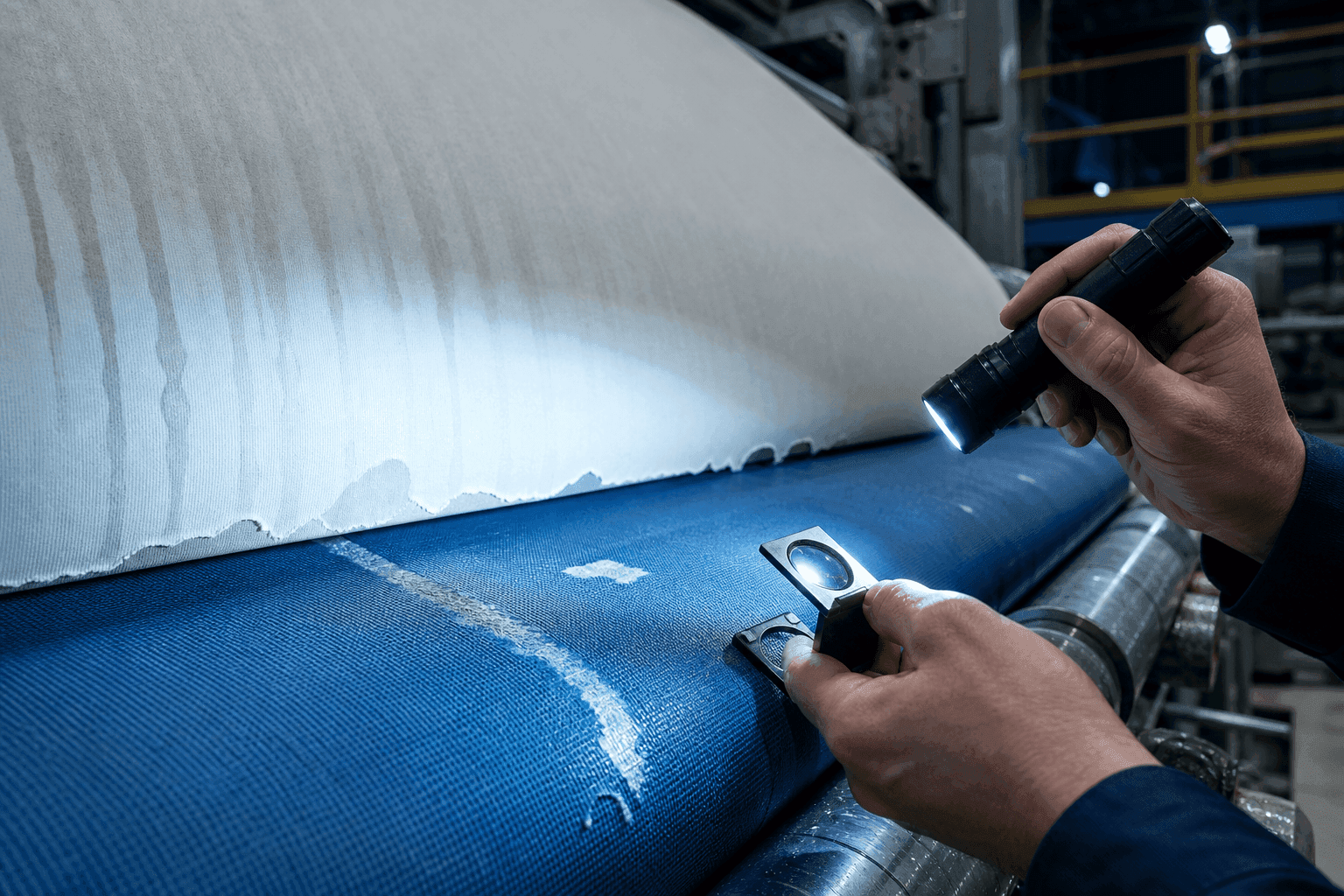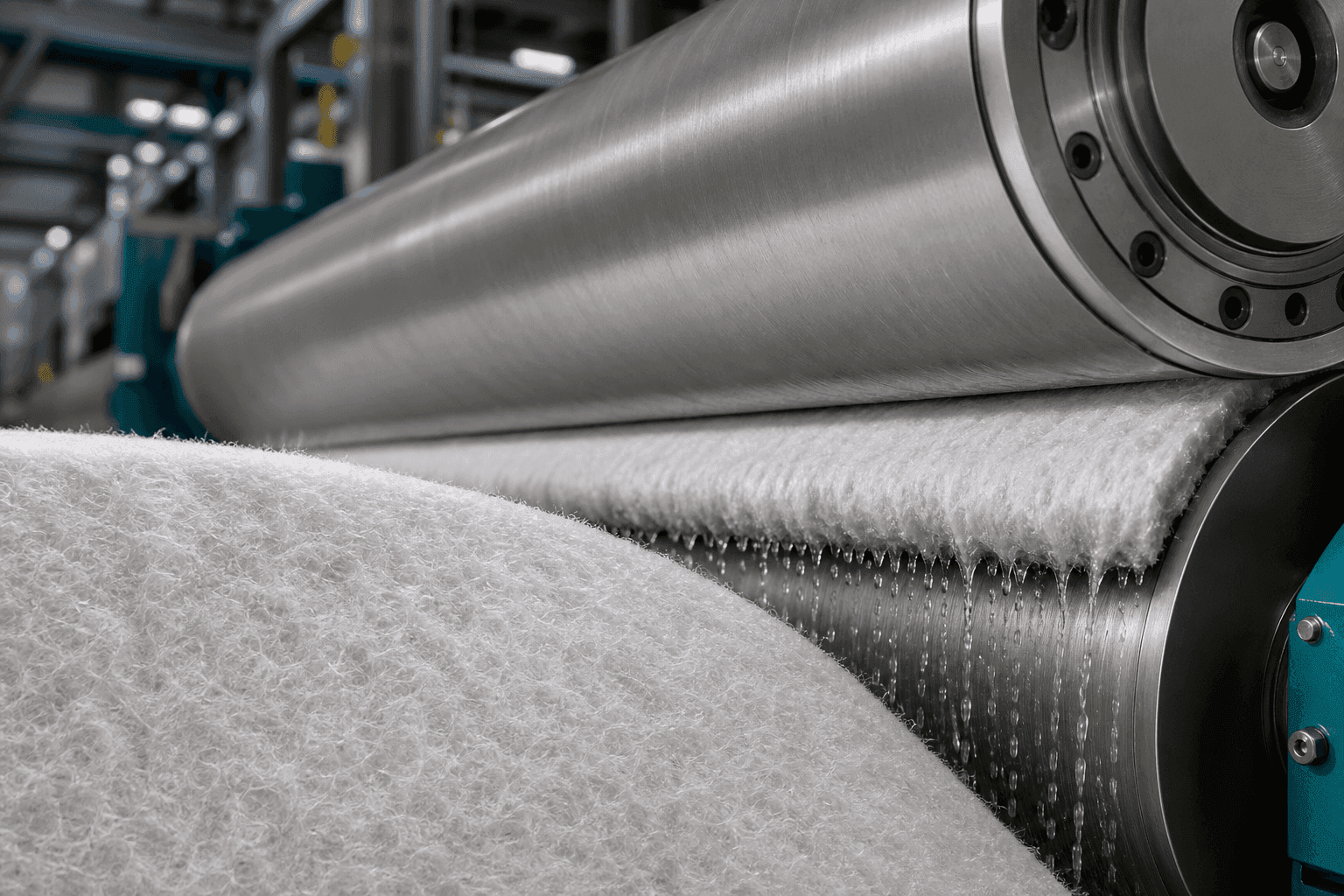
Assess the press felt in its actual position
A press felt should be assessed in the context of its own press position, paper grade and running conditions. A single appearance check or one instrument reading rarely explains whether a felt needs attention, a planned change, or a broader press-section review.
Start by recording what operators are seeing: the precise position, current felt identification, paper grade, usual operating conditions, start date, and the observation that prompted the review. This creates a useful technical record without assuming that every press felt should behave the same way.
See the complete Paper Machine Clothing system and the press felt product range.
Begin with safety and a repeatable inspection method
Follow the mill's isolation, guarding and safety procedures before inspecting any moving equipment. Use the same inspection route, lighting and record format whenever practical. A repeatable process makes it easier to distinguish a real change from a difference in observation.
The goal is not to diagnose a press section from one checklist. It is to gather enough consistent information for the mill and technical supplier to review the condition together.
1. Record the condition that triggered the assessment
Describe the observation in operational terms. Examples may include a change in dewatering behaviour, visible marking, contamination, a change near an edge, uneven appearance, or an unexpected condition during a scheduled shutdown. Note when it began and whether it is limited to one position or appears across several positions.
| Record | Why it matters |
|---|---|
| Exact press position | Keeps the discussion tied to the correct duty |
| Paper grade and current production context | Provides context for the web and press operation |
| Felt identification and installation date | Helps trace the item being reviewed |
| Location and pattern of the observation | Separates a local issue from a general condition |
| Recent operating or maintenance changes | Identifies changes worth checking without assuming causation |
2. Review moisture and dewatering observations as a trend
When dewatering is a concern, compare like-for-like production records rather than relying on one isolated result. Note the measurement method, location, paper grade and operating context. If the process has changed, record that change alongside the observation.
Poor nip dewatering can involve more than the felt itself. Before assigning a cause, review the press position, conditioning practice, roll and shower condition, and the operating history available to the team. This poor-nip dewatering review provides a structured starting point.
3. Inspect the felt surface and edges
During an approved inspection, record visible contamination, local damage, abnormal surface appearance, edge condition and the direction of any pattern. Photos taken from the same distance and position are often more useful than a general description alone.
Do not treat an edge symptom as proof of one cause. Guide alignment, contact conditions, local cleaning, installation details and the specific felt position may all need review. For a symptom-led workflow, see Press Felt Troubleshooting.
4. Check conditioning and cleaning information
Confirm what conditioning, shower and cleaning steps are currently used, who last adjusted them, and whether the observed condition changed after any maintenance action. Record the actual practice rather than relying on a standard description of the machine.
This gives the technical review a clear timeline. It also helps avoid changing several variables at once and then losing the ability to understand what changed.
5. Compare tension and tracking records carefully
Tension readings are meaningful only with their measurement context. Record the instrument, location, procedure, machine condition and date. Do not compare values from different tools or procedures as if they are automatically equivalent.
If tension or tracking needs review, use a controlled record before making an adjustment. Paper Machine Fabric Tension Checks explains what to document first for forming fabrics, press felts and dryer fabrics.
6. Decide whether the next step is monitoring, technical review or replacement planning
The assessment should lead to a defined next action, not a generic conclusion. Depending on the evidence, the next step may be continued monitoring with a defined record, a joint technical review, an inspection during a planned stop, or a replacement-planning discussion.
Replacement planning is more useful when the mill can state the exact position, dimensions, seam or installation constraints, current felt details, paper grade and the condition being reviewed. This turns a broad request into information an engineer can assess.
When permeability is part of the review, use the press-felt permeability RFQ field-data checklist to record the test method and context rather than sending an isolated value.
A supplier-ready press-felt assessment checklist
Before asking a supplier to assess a press felt, prepare:
- Paper machine section and exact press position.
- Paper grade and the operating context for the observation.
- Felt identification, dimensions and installation information.
- A dated description of the condition and where it appears.
- Comparable moisture, process, tension or tracking records where available.
- Photos collected through the mill's approved inspection process.
- Recent changes in cleaning, conditioning, guides, rolls or operating practice.
For a position-specific review, contact the PAPTEX engineering team. The objective is a documented review of the machine condition—not a universal replacement decision.
Frequently asked questions
Can I assess a press felt from its visual appearance alone?
Visual evidence is useful, but it should be reviewed with the position, operating record and inspection context. A single appearance check cannot establish every cause or next action.
What should I send with a press-felt enquiry?
Send the exact press position, paper grade, felt details and dimensions, the observed condition, relevant operating records, and approved photos or drawings where available.
Does a change in dewatering always mean the felt is the cause?
No. Dewatering observations should be assessed with the wider press-section conditions. The review should make unknowns and recent changes visible before a corrective action is selected.